All property owners (buildings constructed prior to 2010) must, as far as is reasonably practicable ensure that all Asbestos-containing materials on the property are identified by a competent person.
Asbestos Inventory (Regulation 4)
All property owners with identified Asbestos on their property must obtain the services of a competent person to ensure that all materials identified as, or assumed to be, Asbestos-containing material, as contemplated in Regulation 3 of the Asbestos Abatement Regulations 2020, are entered into an Asbestos Inventory, which must be kept at the property.
Asbestos Risk Assessment (Regulation 5)
If Asbestos is identified in terms of Regulation 3 of the Asbestos Abatement Regulations 2020, then the property owner must ensure that an Asbestos Risk Assessment is carried out, as far as is reasonably practicable, immediately by a competent person and thereafter at intervals not exceeding 24 months.
Asbestos Management Plan (Regulation 6)
If Asbestos-containing materials are identified as required in Regulation 3 of the Asbestos Abatement Regulations 2020, the property owner must ensure that a written Asbestos Management Plan for the property is prepared by a competent person.
Asbestos Air Monitoring (Regulation 16)
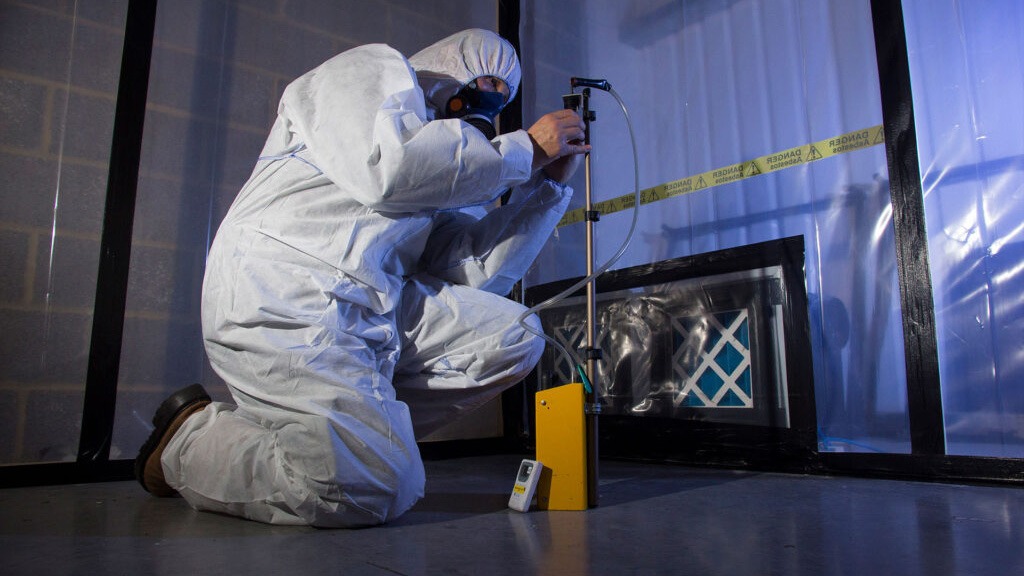
In case of type 2 and type 3 Asbestos work, the Asbestos client must ensure that Air Monitoring of the concentration of airborne regulated fibres to which an employee may be exposed is:
Performed by an approved inspection authority
Carried out in terms of HSG 248
Representative of employee exposure, and
Carried out at frequency determined by the approved inspection authority based on the site-specific Asbestos Risk Assessment.
Asbestos Labelling (Regulation 20)
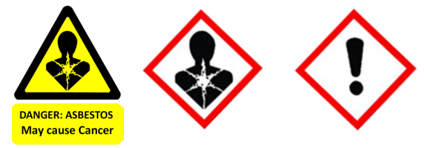
All Asbestos in place listed in the Asbestos Inventory, as required by Regulation 4 of the Asbestos Abatement Regulations 2020, must be clearly and legibly identified using the pictogram below:
Asbestos Awareness Training (Regulation 7)
An employer must provide to persons who may have incidental Asbestos exposure, information, instruction and training.
Where an employee undertakes non-asbestos-related work, where there is potential for exposure to Asbestos dust, the employer must ensure that the employee is adequately and comprehensively informed, instructed and trained in both practical and theoretical knowledge.
In the case of Asbestos or repair of Asbestos-containing materials, as contemplated in Regulation 12 of the Asbestos Abatement Regulations 2020, the employer must ensure that all supervisors and employees are adequately trained in both practical and theoretical knowledge. Training must be provided by a competent person, have a minimum contact of 8 hours and as an outcome, provide employees with Asbestos Training Certificates.
Carried out at frequency determined by the approved inspection authority based on refresher training with a minimum contact of 2 hours must be provided at least annually.
Registration of Asbestos Contractors with the Department of Employmentand Labour
In terms of the Asbestos Abatement Regulations 2020, any person who intends to carry out Asbestos work must be a Registered Asbestos Contractor before commencing with any Asbestos work. Amianté Occupational Hygiene Services can assist you with the Registration process, the compiling of an Asbestos Registration File and submitting your application to the Department of Employment and Labour.
Hazardous Material Assessments
Amianté Occupational Hygiene Services can efficiently and effectively assess and quantify hazardous materials present on your property whether it is vacant or operational or prior to renovation or demolition. Proper identification and management of hazardous materials is critical.
HCI (Hazardous Chemical Inventories)
Ergonomic Risk Assessments (Level 1 and 2)
Amianté Occupational Hygiene Services outsources other professional fields of Occupational Hygiene with our collaborative partners whom are also registered with the Department of Employment and Labour. These include:
Health Risk Assessments
Noise Surveys
Personal Noise Sampling
Noise Surveys
Hazardous Chemical Agents (HCA)
Ergonomic Risk Assessments (Level 3 and 4)
Thermal (heat or cold) Stress Surveys
Microbiological Sampling
Vibration Measurements (Whole Body and Hand-Arm)
Occupational Hygiene
Assessments
Exposure Monitoring
Noise Assessments
Hand-arm Vibration Assessments
LEV Assessments
Indoor Air Quality Assessments
Protect your workers and recognise, evaluate and control the use of chemical, physical and biological agents arising from workplace activity.